Panic Attacks Explained: What They Feel Like and How to Ground Yourself
- Jan 8
- 7 min read
Let's be real, if you've ever had a panic attack, you know it's one of the scariest experiences your body can put you through. And if you haven't experienced one, here's the tea: they affect about 1 in 4 people at some point in their lives, so you're definitely not alone if this is your reality.
The thing about panic attacks is that they don't discriminate. They can hit you in the grocery store, at work, during a Netflix binge, or even while you're sleeping. One minute you're fine, the next minute your body is convinced you're literally dying. But here's what I need you to know right off the bat: panic attacks are not life-threatening, even though they feel like they are.
What a Panic Attack Actually Feels Like
Okay, so you've probably heard the clinical definition, but let me paint you the real picture. A panic attack is like your body's alarm system going completely haywire, imagine a smoke detector that won't stop screaming even though there's no fire.
The physical stuff hits hard and fast:
Your heart starts pounding like it's trying to escape your chest
You can't catch your breath, like someone's sitting on your lungs
Sweating starts even if it's cold outside
Your hands shake and get tingly or numb
Your chest hurts so bad you're convinced it's a heart attack
You feel dizzy, like you might pass out any second
Nausea hits and your stomach feels like it's doing backflips
You get hot flashes or suddenly feel freezing cold
Your throat feels tight, like you're choking

But the mental part? That's where it gets really scary:
The overwhelming fear that something terrible is about to happen. Your brain starts racing with thoughts like "I'm dying," "I'm losing my mind," or "I can't control this." You might feel disconnected from your body, like you're watching everything happen to someone else. Some people describe it as feeling like they're in a dream or floating outside themselves.
The whole experience usually peaks within about 10 minutes, but those can feel like the longest 10 minutes of your life. Most panic attacks last anywhere from 5 to 20 minutes, though some can stretch up to an hour. And afterwards? You're completely drained, like you just ran a marathon while solving calculus problems.
Why Your Body Does This to You
Here's the thing, your body isn't trying to hurt you. Panic attacks happen when your brain's alarm system (the amygdala, if you want to get technical) gets triggered and floods your system with stress hormones. It's your fight-or-flight response kicking into overdrive, preparing you to either battle a saber-tooth tiger or run for your life.
The problem is, there's no actual tiger. Your brain just thinks there is.
This can happen because of stress, certain triggers, genetics, or sometimes seemingly out of nowhere. The frustrating part? Once you've had one panic attack, the fear of having another one can actually trigger more attacks. It's like your anxiety has anxiety, which is honestly just rude.
Real Talk: Panic in Black/Brown Urban Life
Quick stat check: Black and Brown communities often face higher exposure to chronic stressors (racism, policing, community violence, and stack-on-stack bills) while getting less access to quality mental health care. That mismatch can make panic feel louder, faster, and way more frequent. If you grew up hearing “be strong,” “what happens in this house stays in this house,” or “just pray on it,” you’re not imagining it—stigma and survival mode shape how you move.
Common urban triggers you might recognize:
Sirens, loud bangs, fireworks, or sudden yelling on the block
Crowded buses/subways, store security checks, or police presence
Microaggressions at work/school and code-switching fatigue
Rent hikes, housing instability, gentrification stress
Breaking news or viral videos about violence in our communities
Street-smart coping moves that respect your reality:
Siren-safe breathing: When you hear sirens, try box breathing (in 4, hold 4, out 4, hold 4) until the sound fades. Pair breath with a grounding phrase: “I’m here. I’m safe. This will pass.”
Commute micro-ritual: On the train or bus, pick a landmark (next 4 stops, the mural on 16th) and cycle 4 slow breaths per landmark. Headphones in, eyes on one steady object.
Sensory anchor: Keep a tiny “go” kit—mint gum, a drop of your favorite oil (shea/coconut/vanilla), cold water, and a smooth coin. When panic spikes, chew, sniff, sip, and rub the coin’s edges to bring your body back online.
Ground with sound: Build two playlists—one soothing (quiet storm, gospel, lo-fi, boleros) and one empowering (Afrobeats, reggaetón, hip-hop). Breathe to the beat: inhale 4 counts on the verse, exhale 6 on the hook.
Salon/barbershop reset: If you can, step into community spaces (salon, barbershop, bodega hello, church/mosque foyer). A 5-minute chat and eye contact can regulate your nervous system more than doomscrolling ever will.
Faith + therapy can coexist: Prayer, meditation, or devotion can be your anchor—and a therapist can be your teammate. Both/and, not either/or.
Space scan without spiraling: In crowded spots, just note exits, pick a wall for your back, and soften your knees. You’re not “paranoid”—you’re creating safety.
Scripts to push back on stigma (use or tweak):
“Therapy is self-care so I can show up for us long-term.”
“Prayer and therapy aren’t rivals—they’re a tag team.”
“I’m not being dramatic; my body is overprotecting me. I’m learning new skills.”
If trauma is part of your story—profiling, community violence, sudden losses—your nervous system is doing what it was built to do: protect you. Healing takes time, safety, and practice. Pick one or two of the moves above this week and save them in your Notes app so future-you has a plan.
Grounding Techniques That Actually Work
When a panic attack hits, your mind goes to scary places fast. Grounding techniques help bring you back to the present moment and remind your body that you're actually safe. Here are some techniques that can help when you feel that familiar wave of panic starting to build:
The 5-4-3-2-1 Technique
This is your go-to when you need to get out of your head quickly:
5 things you can see (the wall, your phone, a plant, whatever)
4 things you can touch (your clothes, a table, your hair)
3 things you can hear (traffic, music, your own breathing)
2 things you can smell (coffee, your perfume)
1 thing you can taste (gum, that leftover coffee taste)
Box Breathing
This one's simple but powerful:
Breathe in for 4 counts
Hold for 4 counts
Breathe out for 4 counts
Hold empty for 4 counts
Repeat until you feel more centered
Cold Water Reality Check
Splash cold water on your face, hold an ice cube, or put your hands under cold running water. The shock to your system can interrupt the panic response and bring you back to the present.
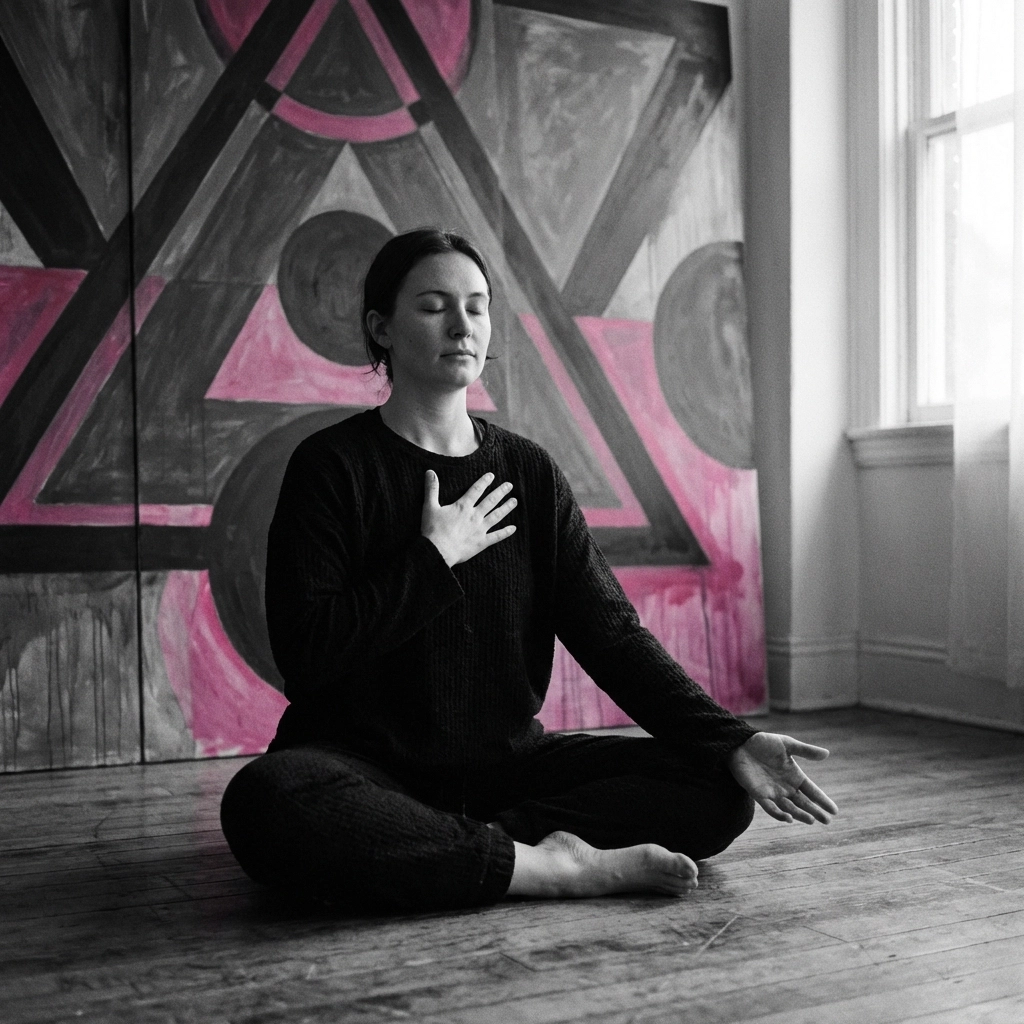
Progressive Muscle Relaxation
Start at your toes and work your way up, tensing each muscle group for 5 seconds, then releasing. It sounds weird, but it works by giving your body something concrete to focus on instead of the panic.
The "Panic Attack Mantra"
Create a phrase you can repeat when panic hits. Something like:
"This is temporary and I am safe"
"I've survived this before and I'll survive it again"
"This feeling will pass"
"I am not in danger, my body is just confused"
During the Attack: Your Survival Guide
When you're in the middle of a panic attack, remember these crucial points:
Don't fight it. I know this sounds counterintuitive, but trying to force a panic attack to stop often makes it worse. Instead, acknowledge it: "Okay, I'm having a panic attack right now, and that's scary, but I know what this is."
Find a safe space. If you're in public, try to get somewhere you feel more comfortable: a bathroom, your car, or even just sit down where you are. Don't worry about what people think; your mental health comes first.
Use your phone. Call someone who gets it, text a trusted friend, or even use a meditation app. Sometimes just hearing a familiar voice can help ground you.
Remember it will end. Panic attacks have a beginning, middle, and end. Even when it feels endless, your body literally cannot maintain that level of intensity forever.
After the Storm: Recovery Mode
Once a panic attack passes, you're probably going to feel wiped out. That's completely normal: your body just went through a major stress response. Here's how to take care of yourself in recovery mode:
Rest without guilt. You might need to sleep, and that's okay
Hydrate and eat something gentle if you feel up to it
Practice self-compassion. Don't beat yourself up about having a panic attack
Journal about it if that helps you process
Plan for next time by noting what techniques helped
Building Your Support Network
Dealing with panic attacks can feel isolating, but you don't have to handle this alone. Consider connecting with others who understand what you're going through. The Mental Health Hub on our forum is a supportive space where you can share experiences and get advice from people who really get it.
When to Seek Professional Help
If panic attacks are happening frequently, interfering with your daily life, or causing you to avoid certain places or situations, it's time to talk to a professional. Therapy, particularly cognitive behavioral therapy (CBT), has been shown to be highly effective for panic disorder. Sometimes medication can also help while you're learning coping strategies.
You deserve to feel safe in your own body, and there are people trained to help you get there.
Resources That Can Help
Crisis Text Line: Text HOME to 741741
National Suicide Prevention Lifeline: 988
SAMHSA National Helpline: 1-800-662-4357
Anxiety and Depression Association of America: adaa.org
Psychology Today Therapist Finder: psychologytoday.com
Culturally rooted support and directories:
Therapy for Black Girls: therapyforblackgirls.com
Therapy for Black Men: therapyforblackmen.org
BEAM (Black Emotional and Mental Health Collective): beam.community
The Boris Lawrence Henson Foundation: borislhensonfoundation.org
The Loveland Foundation (Therapy Fund for Black women and girls): thelovelandfoundation.org
The Steve Fund (Mental health for young people of color): stevefund.org
Latinx Therapy: latinxtherapy.com
NQTTCN (National Queer and Trans Therapists of Color Network): nqttcn.com
Sista Afya Community Mental Wellness: sistaafya.com
Inclusive Therapists (Culturally responsive providers): inclusivetherapists.com
Remember, seeking help isn't a sign of weakness: it's a sign that you're ready to take control of your mental health.
You're Stronger Than You Think
Having panic attacks doesn't make you weak, broken, or "crazy." Your brain is just trying to protect you in a way that's not super helpful right now. But with the right tools and support, you can learn to manage panic attacks and reduce their frequency.
The most important thing to remember? This isn't your fault, and you're not alone. Millions of people deal with panic attacks, and many of them go on to live full, amazing lives. You can too.
If you're supporting someone through panic attacks, check out our Mental Health forum for tips on how to be there for someone during their most vulnerable moments.
Your mental health journey is valid, your struggles are real, and your healing is worth investing in. Keep going, bestie( you've got this.) 💪
Comments