Top Dawg Entertainment Faces Explosive Lawsuit Alleging Sexual Misconduct and Doxxing
- Shalena
- Feb 21, 2025
- 3 min read

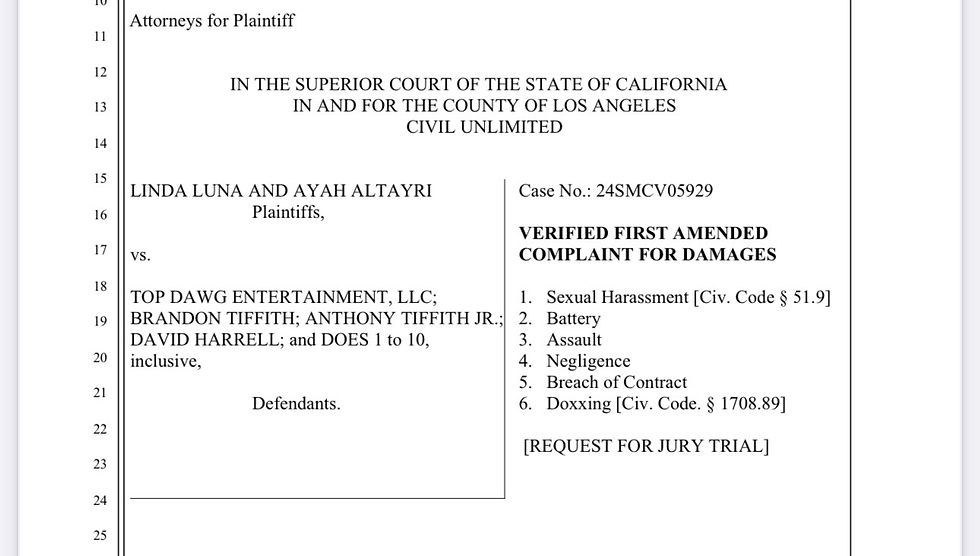
Top Dawg Entertainment (TDE), the influential record label finds itself embroiled in a high-stakes legal battle. Two women—one a former worker and the other claiming a business relationship with the label—have filed a lawsuit alleging rampant sexual harassment, assault, and a hostile work environment perpetuated by several TDE executives and employees. The case, initially filed anonymously in December 2024 in Los Angeles Superior Court, has escalated with a recent amendment accusing the label of doxxing the plaintiffs, thrusting TDE into a public relations and legal firestorm.
The Allegations
The plaintiffs, initially identified as Jane Doe and Jane Roe, accuse TDE of fostering a "pervasive culture of sexual harassment" that went unchecked by its leadership. Among the named defendants are Brandon "Big B" Tiffith, TDE’s Chief Marketing Officer, and Anthony "Moosa" Tiffith Jr., the label’s President—both sons of founder Anthony "Top Dawg" Tiffith. According to the complaint, one plaintiff alleges that Brandon Tiffith made unwanted sexual advances and committed sexual battery, while both women claim Anthony Tiffith Jr. engaged in ongoing harassment. A second plaintiff recounts multiple incidents of assault by TDE employees, including an episode where employee David Harrell allegedly pressured her, then underage, to drink alcohol as a means to exploit her sexually.
The lawsuit paints a grim picture of TDE’s internal culture, asserting that management ignored repeated complaints about misconduct. The plaintiffs argue this negligence violated California labor laws, breached contracts, and caused severe emotional and economic harm. They seek unspecified damages for distress, lost opportunities, and punitive measures to hold TDE accountable.
TDE’s Response and the Doxxing Twist
In early February 2025, TDE’s attorney, Marty Singer, fired back, labeling the suit a "shakedown lawsuit" driven by "fabricated claims." Singer’s statement to the press on February 1 claimed the women—later identified as Linda Luna and Ayah Altayri—demanded $48 million to settle and were never TDE employees. He pointed to text messages and communications allegedly contradicting their narrative, framing the case as an extortion attempt.
However, the plaintiffs dispute this. Linda Luna took to Instagram, posting what she claims is proof of her work with TDE, declaring, "This is my truth and I am finally standing up for myself." The controversy deepened on February 19, when Luna and Altayri amended their complaint, adding a doxxing claim against TDE. They allege Singer’s public disclosure of their identities—despite their initial anonymity—violated their safety, triggering a wave of online harassment, including rape and death threats. The amended filing includes detailed evidence: text message screenshots, a recorded conversation, and sworn statements reinforcing their accusations.
A Label Under Scrutiny
Founded in 2004 by Anthony "Top Dawg" Tiffith, TDE rose to prominence as a powerhouse in hip-hop and R&B, launching the careers of Kendrick Lamar (who departed in 2022), SZA, ScHoolboy Q, and others. None of these artists are implicated in the lawsuit, and TDE has remained silent beyond Singer’s initial rebuttal. The timing of the case’s publicity—weeks before the 2025 Grammy Awards and Kendrick Lamar’s slated Super Bowl LIX halftime performance—has sparked online chatter about possible ulterior motives, though no concrete evidence supports such theories.
Legal experts suggest the amended complaint strengthens the plaintiffs’ position by introducing the doxxing angle, a serious accusation under California’s privacy laws. "If proven, this could shift the narrative from a he-said-she-said dispute to a broader violation of rights," said Los Angeles-based attorney Sarah Klein. "The evidence—like texts and recordings—will be critical."
So What’s Next?
As of today, February 20, 2025, the case remains in its early stages, with TDE yet to file a formal response to the amended complaint. The plaintiffs’ legal team has vowed to pursue justice, while TDE’s camp appears poised to challenge the credibility of Luna and Altayri. The outcome hinges on the court’s assessment of the evidence, which both sides claim bolsters their version of events.
For TDE, the stakes are high. Beyond potential financial penalties, the label risks reputational damage in an industry increasingly scrutinized for its treatment of women. Fans and observers alike are watching closely, with social media debates already raging over accountability, truth, and the legacy of a label once hailed as a creative beacon.
As the legal process unfolds, one thing is clear: this lawsuit has cast a long shadow over TDE’s storied run, with no resolution in sight.


Comments